 how-to
7 Irrigation System Water Saving Tips That Cut Your Bill
Last Updated: November 2, 2026
Quick Summary
Irrigation system water saving tips start with a structured audit of every zone, head, and valve, which takes about an hour and shows exactly where water is lost. From there, water deeply two or three times a week in the early morning and let a smart controller adjust run times using local weather data.
- An irrigation audit takes about an hour and checks each zone, head, and valve.
- Water deeply two or three times a week rather than lightly every day.
- Run zones in the early morning to limit evaporation.
- Sandy soil needs longer, less frequent watering to reach the root zone.
- Read your meter before and after a schedule change to measure savings.
Table of Contents
- Irrigation System Water Saving Tips That Start With a Real Audit
- Smart Irrigation System Water Saving Tips for Scheduling and Weather
- Irrigation System Scheduling Built Around Sandy Soil and Summer Rain
- Drip Irrigation and Efficient Sprinkler Heads That Cut Waste
- Sprinkler System Leak Detection and Simple Fixes
- Measuring Your Water Savings and Knowing When to Call
- Frequently Asked Questions
Irrigation System Water Saving Tips That Start With a Real Audit
Irrigation system water saving tips often begin with a walk-through of your own yard. Systems running on old schedules can waste water every week, which is why a yard check is a useful first step. A University of Georgia Cooperative Extension report on automated irrigation notes that homeowners with automated systems often water too much, too often.
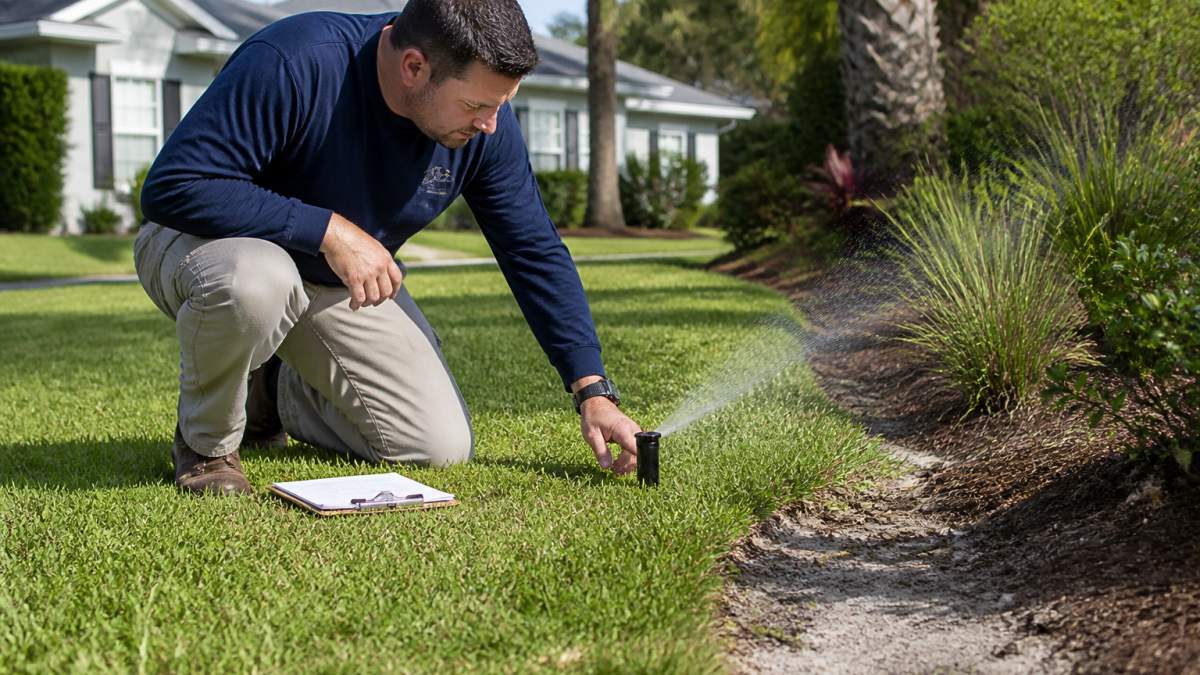
An irrigation audit is a structured check of every zone, head, and valve, taking about an hour to show exactly where water is lost.
- Map your zones. Write down what each zone waters and how long it runs.
- Run each zone and watch. Look for misting, geysers, and water running down the street.
- Check spray direction. Heads should water plants and turf, not pavement or siding.
- Look for leaks and clogs. A broken head can waste more water than a dry bed needs.
- Note low spots. Sandy soil here drains fast, but flat coastal lots still pool after storms.
The EPA WaterSense tune-up guidance breaks system checks into four actions: inspect, connect, direct, and select. That is the same order we follow on every service call.
If your yard is small and you are rethinking the layout, our guide on how to landscape a small yard pairs well with an audit.
Smart Irrigation System Water Saving Tips for Scheduling and Weather
Smart controllers adjust run times using local weather data instead of a fixed clock, which can reduce unnecessary watering.
- Water deeply two or three times a week, not lightly every day.
- Run zones in the early morning to limit evaporation.
- Shut the system down after real rain, not just a cloudy sky.
Cornell University researchers found that a model combining soil conditions and weather forecasts could save up to 40% of water, according to the Cornell Chronicle report. A rain sensor and a weather-based schedule get you most of the way.
Irrigation System Scheduling Built Around Sandy Soil and Summer Rain
Sandy soil changes everything about irrigation system scheduling. Water moves through it fast, so short daily runs mostly feed weeds and evaporate; longer, less frequent watering pushes moisture to the root zone where turf and shrubs use it.
Our summer pattern looks like this:
| Season | Runs per Week | Best Time | Watch For |
|---|---|---|---|
| Spring | 2 | 4-7 a.m. | New sod drying out |
| Summer | 2-3 | 4-6 a.m. | Afternoon storms, runoff |
| Fall | 1-2 | 6-8 a.m. | Shorter days, cooler soil |
| Winter | 1 or off | Mid-morning | Overwatering, fungus |
Heavy coastal rain is the wild card. Amelia Island and Fernandina Beach get soaked stretches followed by dry ones, so a fixed schedule rarely fits two weeks in a row.
Drip Irrigation and Efficient Sprinkler Heads That Cut Waste
Drip irrigation delivers water straight to the root zone, suiting planting beds far better than overhead spray. Drip systems generally perform best with a pressure regulator, filter, and one emitter type per zone.
For turf, rotary nozzles can throw water more slowly than older fixed-spray heads, which helps sandy soil absorb it. A pressure regulator can also help prevent misting.
Watch out: mixing drip and spray heads on one zone usually means one half gets drowned while the other stays dry.
Sprinkler System Leak Detection and Simple Fixes
Sprinkler system leak detection starts with your water bill and your eyes. A spike with no weather change can point to an underground leak or stuck valve; look for soggy patches, sunken turf, or a zone that never dries.
Measuring Your Water Savings and Knowing When to Call
You cannot manage what you do not measure. Read your meter before and after a schedule change, and compare the same month year over year.
If your system is old, has mixed zones, or keeps leaking, a professional inspection can help identify the cause. Veterans Landscape Management handles irrigation repair and installation across Fernandina Beach, Amelia Island, Yulee, and Nassau County. Contact us for an inspection, consultation, or estimate.
Frequently Asked Questions
How can I tell if my sprinkler system is wasting water?
Run each zone for a few minutes and watch for water running down the driveway, pooling on the grass, or spraying onto sidewalks and fences. Check for soggy spots that stay wet days after rain and for heads that mist or geyser. The EPA WaterSense tune-up guidance groups the fix around four actions: inspect, connect, direct, and select.
Can a smart controller really help with irrigation water saving?
Yes, when it is programmed for your soil and plant types. A smart controller tends to deliver better results when it is set up for your soil and plant types and adjusted after large rain events.
Is a drip irrigation system more water-efficient than sprinklers?
For planting beds, trees, and palms, usually yes. Drip delivers water to the root zone instead of throwing it into the air, so less is lost to wind and evaporation. Drip systems generally work best with a pressure regulator and filter, and one type of emitter per zone. Turf still needs spray or rotary heads, so most coastal Northeast Florida yards work best with a mix of both.
Water waste rarely comes from one big mistake. It comes from a dozen small ones running quietly every week. Veterans Landscape Management can audit your system, reprogram your controller, and fix the leaks and heads that drain your bill, with discounted rates for active military, retired veterans, and first responders. Get started with Veterans Landscape Management and put every gallon to work on your landscape.